Choosing between rail and truck transportation depends largely on how far freight needs to travel, how much cargo must be moved and how quickly it must arrive. Rail is often more economical for large shipments travelling long distances, while trucks offer greater flexibility, direct delivery and faster service over shorter routes. Understanding these differences helps shippers evaluate rail vs truck shipping based on actual transportation requirements rather than comparing freight rates alone. MB Rail helps businesses coordinate freight transportation services options that match their cargo, routes and delivery requirements.
The right decision requires more than identifying the lower quoted price. Shipment weight, cargo volume, loading facilities, delivery locations, transit schedules and additional handling expenses can all affect the final transportation cost. A suitable shipping method should balance these factors while supporting the shipment’s operational requirements.
1. How Shipment Distance Changes the Transportation Decision
Distance is one of the first factors to consider when comparing rail and truck transportation. The cost structure of each mode changes as the distance between the origin and destination increases.
Trucks are generally practical for short and medium-distance transportation because they can collect freight directly from a facility and deliver it to the receiving location. Rail becomes more attractive for long-distance movements, particularly when businesses transport large quantities of goods between locations connected to the rail network.
Rail Shipping for Long-Distance Freight
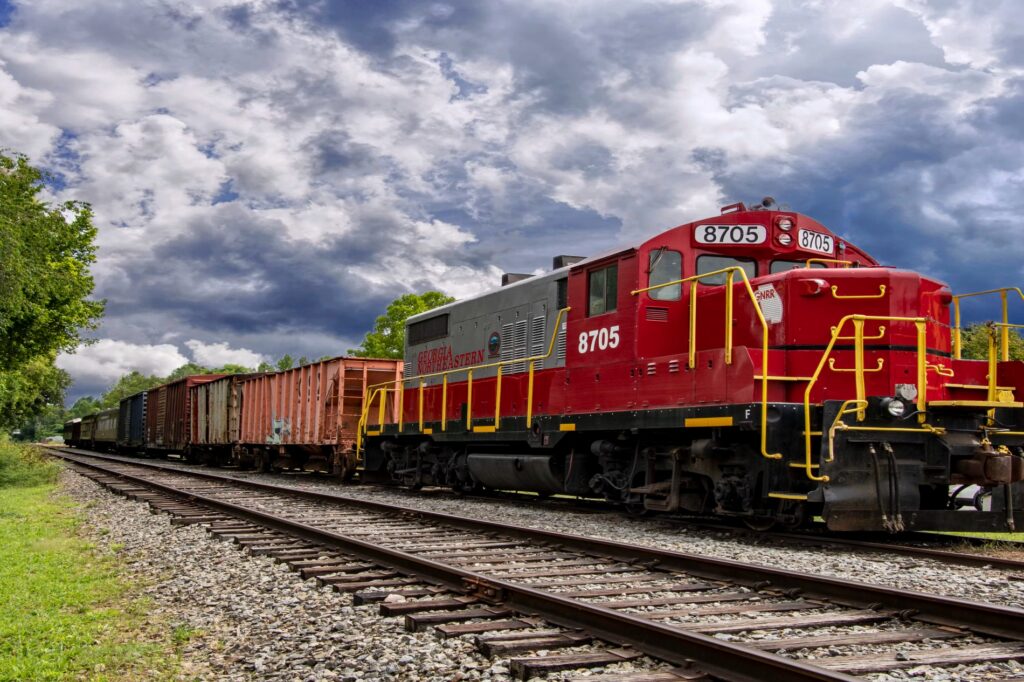
Rail transportation is commonly used for freight moving across regional or national networks. A single train can carry substantial cargo, allowing rail operators to distribute transportation costs across multiple shipments.
For businesses moving heavy materials, industrial goods, agricultural commodities or large quantities of packaged products, rail can offer cost advantages over extended distances.
Rail shipping distance also affects the overall economics of a shipment. Longer routes can make rail more competitive because the cost of moving large freight volumes can be distributed across a greater transportation distance.
However, rail freight usually requires additional transportation arrangements at both ends of the journey. Cargo may need to travel by truck between the shipper’s facility, a rail terminal and its final destination.
Truck Freight for Shorter Routes
Truck transportation is particularly useful when freight must travel directly between facilities without an intermediate rail movement.
It offers several practical advantages:
- Direct collection and delivery: Trucks can collect cargo from warehouses, factories and distribution centres.
- Route flexibility: Carriers can use road networks to reach locations without rail access.
- Shorter-distance efficiency: Trucks can be economical for shipments that do not travel far enough to benefit from rail transportation.
- Flexible scheduling: Businesses can arrange collections and deliveries according to their operating schedules.
For longer journeys, truck transportation may still be appropriate when delivery deadlines, route availability or cargo requirements make it the more suitable option.
2. Rail vs Truck Shipping Costs: What Determines the Difference?
The comparison of rail vs trucking costs should include the entire transportation process rather than just the initial freight rate.
For a more detailed breakdown of line-haul charges, fuel expenses, drayage, terminal handling and other transportation costs, see this rail vs. truck freight total-cost comparison for long-haul shipping.
Rail transportation often offers a lower per-unit cost for large shipments over long distances. Truck transportation can have a higher cost per unit for comparable long-haul volumes, but it may eliminate additional handling and transfer expenses.
The actual difference depends on shipment size, route availability, equipment requirements, fuel expenses and terminal access.
Factors That Affect Rail Freight Costs
Rail freight pricing generally depends on:
- Shipment weight and volume: Larger shipments can distribute transportation expenses across more cargo.
- Transportation distance: Longer movements may improve the cost efficiency of rail.
- Commodity type: Different cargo categories require different railcars, handling arrangements and operating considerations.
- Rail access: Origin and destination facilities need suitable rail connections or access to rail transloading services.
- Terminal handling: Loading, unloading, storage and transfer expenses can increase the total cost.
- Additional transportation: Trucks may be required to move freight between rail terminals and final destinations.
Factors That Affect Truck Freight Costs
Truck freight pricing is influenced by several operating conditions:
- Distance travelled: Longer routes generally increase fuel, driver and equipment expenses.
- Shipment weight: Heavy cargo can affect equipment selection and permitted payload.
- Trailer requirements: Flatbed, dry van, refrigerated and specialised trailers have different pricing structures.
- Fuel prices: Changes in fuel costs can influence transportation rates.
- Route conditions: Tolls, congestion, road restrictions and route availability affect operating expenses.
- Backhaul availability: The availability of return loads can influence carrier pricing.
Comparing the Total Transportation Expense
A lower quoted rate does not always mean a lower overall shipping cost.
For example, a manufacturer shipping a large quantity of steel products over a long distance might receive a competitive rail freight rate. However, the business must also account for loading, terminal handling, rail-to-truck transfers and final delivery.
A truck shipment might have a higher line-haul rate but require fewer transfers and less coordination.
The following table highlights the main cost differences.
| Cost factor | Rail transportation | Truck transportation |
|---|---|---|
| Long-distance freight | Often more economical for large volumes | Can have higher per-unit costs |
| Short-distance freight | Terminal access may reduce cost advantages | Often practical and economical |
| Large shipments | Efficient for substantial cargo volumes | Depends on available vehicle capacity |
| Loading and unloading | May require terminal handling | Often direct at pickup and delivery points |
| Additional transportation | Drayage may be required | Direct delivery may eliminate transfers |
| Fuel expenses | Distributed across large cargo volumes | Influenced by vehicle, distance and fuel prices |
| Specialised equipment | Depends on railcar availability | Depends on trailer and vehicle requirements |
Businesses should request an estimate that includes all transportation stages before making a final decision.
3. How Shipment Size and Volume Influence the Choice
Shipment size is another major consideration in the rail freight vs truck freight comparison.
The quantity of cargo determines how efficiently transportation capacity can be used. A small shipment may not justify rail transportation because the additional handling and terminal arrangements can outweigh the line-haul savings.
Larger shipments can make rail more attractive because substantial quantities of goods can move together.
When Truck Transportation Makes More Sense for Smaller Loads
Truck transportation is generally suitable for shipments that do not require an entire railcar or large freight capacity.
Common examples include:
- Small quantities of manufactured products.
- Individual pallet shipments.
- Urgent replacement parts.
- Machinery components requiring direct delivery.
- Freight moving between nearby warehouses.
Depending on the shipment size, businesses can use less-than-truckload (LTL) or full truckload (FTL) services.
LTL allows multiple shippers to share available trailer space, while FTL dedicates the vehicle to one shipment.
When Rail Works Better for Large Shipments
Rail can offer advantages for businesses transporting substantial quantities of goods regularly.
Examples include:
- Agricultural commodities such as grain.
- Steel, iron and other industrial materials.
- Construction materials.
- Chemicals and other suitable bulk commodities.
- Large quantities of manufactured products.
Railcars can carry significant cargo volumes, reducing the need for multiple individual truck movements over long distances.
However, the available railcar type, payload limits, loading arrangements and receiving facilities must match the freight requirements.
Shipment Volume and Transportation Mode
Businesses should evaluate both the physical size and total weight of their cargo.
A shipment might be heavy but occupy relatively little space, while another might be lightweight but require considerable loading capacity. These differences affect equipment selection and transportation pricing.
The following comparison provides a practical starting point.
| Shipment requirement | More suitable option |
|---|---|
| Small shipment requiring direct delivery | Truck |
| Large quantities moving over long distances | Rail |
| Frequent deliveries to multiple locations | Truck |
| Heavy industrial materials | Rail or truck, depending on route and quantity |
| Bulk agricultural commodities | Rail |
| Urgent individual shipments | Truck |
| Large recurring freight movements | Rail, where infrastructure is available |
The best option depends on how much cargo needs to move, how frequently it moves and the facilities available at both ends.
4. Truck vs Rail Transit Time: Speed and Delivery Requirements
Transportation time can influence the overall cost of moving freight. A lower freight rate may not provide a financial advantage if the shipment arrives too late and disrupts production or distribution.
Truck vs rail transit time depends on the route, operating schedules, traffic, terminal arrangements and handling requirements.
Truck Transit Time
Truck transportation offers greater control over pickup and delivery schedules. A shipment can often move directly from the loading location to its destination without transferring between transportation modes.
Factors that affect truck delivery time include:
- Distance and road conditions.
- Traffic congestion.
- Driver availability and required rest periods.
- Weather conditions.
- Loading and unloading arrangements.
- Route restrictions and permitted operating hours.
For shorter routes and time-sensitive deliveries, trucks are often the practical choice.
Rail Transit Time
Rail transportation operates according to network capacity, scheduled services, terminal availability and rail operating conditions.
Freight may need to wait for a scheduled departure, and additional time may be required for loading, unloading and transfers.
Rail can still be an effective option for planned long-distance shipments, especially when businesses can schedule inventory movements in advance.
Comparing Delivery Requirements
| Delivery requirement | Truck | Rail |
|---|---|---|
| Urgent short-distance delivery | Usually suitable | Often less practical |
| Direct facility-to-facility movement | Strong advantage | Requires suitable rail access |
| Planned long-distance movement | Suitable | Often economical |
| Frequent small deliveries | Flexible | Less suitable |
| Large scheduled freight movements | Suitable | Often advantageous |
Businesses should compare the complete transit time, including collection, terminal processing, transfers and final delivery.
5. Rail or Truck for Long Distance? Consider the Full Route
Long-distance freight does not automatically belong on rail. The actual route and availability of transportation infrastructure can change the decision.
For example, a shipment travelling between two facilities with direct rail access may benefit from rail transportation. Another shipment covering a similar distance may require extensive trucking at both ends because neither facility has a suitable rail connection.
In the second situation, the additional transfers may reduce the financial advantage of rail.
Situations Where Rail Can Be a Better Choice
Rail may be suitable when:
- Large quantities of freight move over extended distances.
- Origin and destination locations have convenient rail access.
- Cargo can be loaded and unloaded efficiently.
- Delivery schedules allow for planned transportation.
- Regular shipments justify coordinated rail movements.
Situations Where Trucking Can Be a Better Choice
Trucking may be preferable when:
- Freight needs direct pickup and delivery.
- The shipment travels a relatively short distance.
- Cargo volumes are too small for efficient rail movement.
- The destination does not have convenient rail access.
- Delivery deadlines require greater scheduling flexibility.
A route assessment should include the first and final transportation stages, not just the distance travelled by rail or road.
6. Intermodal Transportation: Combining Rail and Truck
Businesses do not always need to choose a single transportation mode for the entire journey. Intermodal transportation combines rail and truck services to use the advantages of both.
For shipments that require a combination of long-distance rail movement and final-mile truck delivery, rail-to-truck transloading services can help reduce transportation expenses while maintaining access to facilities without direct rail connections.
For example, a large shipment might travel most of its distance by rail before a truck completes the final delivery.
This arrangement can help businesses manage long-distance transportation costs while retaining access to facilities that are not directly connected to rail networks.
How Rail-to-Truck Transportation Works
A typical movement may follow these stages:
- Initial collection: A truck collects the freight from the shipper’s warehouse, factory or distribution facility.
- Terminal delivery: The cargo is transported to a suitable rail terminal or transloading facility.
- Rail movement: Freight travels by rail over the main transportation distance.
- Transfer and unloading: Cargo is unloaded or transferred according to the equipment and service arrangement.
- Final delivery: A truck transports the shipment to the receiving facility.
Businesses that need temporary inventory storage between rail arrival and final truck delivery can benefit from transload warehousing with integrated rail-to-truck transfer, which combines freight handling, storage and outbound distribution at one facility.
Rail-to-truck transloading can also be useful when freight must move between different equipment types or when the shipper and receiver do not have direct rail access.
For businesses evaluating rail vs truck shipping, this combined arrangement offers another option beyond selecting one mode exclusively.
MB Rail provides freight transportation and related logistics services that support the movement of goods through different stages of the supply chain.
7. A Practical Framework for Choosing the Right Mode
A structured evaluation helps businesses select transportation based on measurable requirements instead of relying on general assumptions about rail or trucking.
Use these five steps before requesting freight rates:
1. Calculate the shipment size
Determine the total weight, dimensions, volume and number of units. This helps establish the equipment and capacity required.
2. Measure the complete transportation distance
Identify the pickup and delivery locations, available rail connections and the distance between terminals and facilities.
3. Establish the delivery deadline
Determine the required arrival date and account for loading, transfers, terminal processing and unloading.
4. Compare complete transportation costs
Request estimates covering line-haul transportation, fuel charges, handling, rail drayage, storage and additional delivery expenses.
5. Review operational requirements
Consider cargo characteristics, equipment availability, loading facilities, shipment frequency and receiving arrangements.
This process makes the rail vs truck shipping comparison more relevant to the actual movement rather than relying on general rate differences.
Frequently Asked Questions
1. Is rail shipping cheaper than truck shipping?
Rail shipping is often more economical for large shipments travelling long distances because trains can move substantial cargo volumes together. Trucking can be more economical for shorter routes and smaller shipments because it may avoid additional terminal handling and transfers.
2. What distance makes rail shipping more economical?
There is no universal distance at which rail becomes cheaper than trucking. The crossover point depends on freight volume, route availability, terminal access, handling expenses and truck rates. Businesses should compare complete transportation costs for their specific routes.
3. Is truck freight faster than rail freight?
Truck freight is often faster for direct, short-distance movements because trucks can collect and deliver cargo without intermediate transfers. Rail can be suitable for planned long-distance shipments, although terminal processing and scheduled departures can affect transit time.
4. What types of shipments are best suited for rail transportation?
Rail is commonly used for large quantities of agricultural products, steel, industrial materials, construction supplies and other suitable bulk or heavy freight. The cargo must meet the equipment, loading and handling requirements of the rail service.
5. Can businesses combine rail and truck transportation?
Yes. Intermodal transportation combines rail for the main journey with trucks for collection and final delivery. This arrangement is useful for businesses that want to use rail for long-distance freight movements but need trucks to reach facilities without direct rail access.
6. What factors should businesses compare before choosing rail or truck?
Businesses should compare shipment weight, cargo volume, transportation distance, transit time, loading requirements, terminal access, handling expenses and final delivery costs. These factors provide a more accurate basis for selecting a transportation mode.
Make the Right Transportation Decision for Your Freight
Selecting between rail and truck transportation requires a clear understanding of cargo volume, route distance, delivery schedules and total logistics expenses. Rail can offer cost advantages for large, long-distance freight movements, while trucking provides direct access, flexible scheduling and practical solutions for smaller or time-sensitive shipments.
For many businesses, combining both modes can provide an effective balance between transportation cost and delivery requirements. A route-specific assessment helps identify the most suitable arrangement without overlooking handling, terminal or final-mile expenses.
MB Rail supports businesses with freight transportation services, including rail-related logistics, drayage, flatbed shipping, freight brokerage and transloading. Businesses planning a shipment can request a free quote to evaluate their transportation requirements and identify an appropriate freight arrangement.